Supporting Young Children by Supporting Parents: Evidence-Based Strategies

Check out our blog for social-emotional learning articles, news, and more!
Abstract
Research on children’s cognitive and emotional development tells us that most toddlers are naturally driven to explore, seek autonomy, and resist adult limits (Stroufe, 1995; Green, 2014). Tantrums are common in all children. Young children’s limited language comprehension, immature self-regulation skills or certain sensory aversions contribute to meltdowns in response to adult requests and/or unexpected change in schedule. By approximately 4 years of age, as children’s language understanding and emotional regulation and coping skills improve, compliance with parental requests typically increases to about 70%, which is considered developmentally normal. Some resistance to adult
direction is healthy and reflects growing independence.
However, when children resist or refuse parental requests more than two thirds of the time of the time, family functioning, socialization, and safety can become significantly affected. Parents may then feel increasingly stressed, frustrated, or uncertain about how to respond effectively.
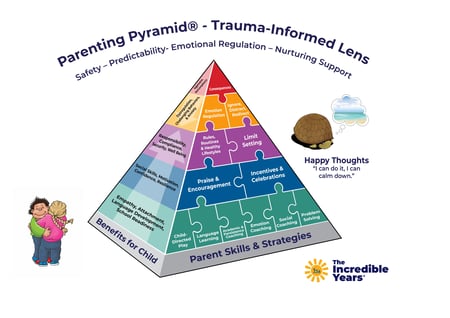
Parents and professionals often ask whether the Incredible Years® approach is appropriate for children who are described as having a PDA (Pathological Demand Avoidance or Persistent Drive for Autonomy) profile. While PDA is not a formal DSM diagnosis, many of the principles that characterize PDA-informed practice—such as reducing unnecessary demands, supporting autonomy, strengthening co-regulation, and maintaining emotional safety—are highly compatible with the Incredible Years® approach.